
Orthopedic Foot and Ankle Surgeon in Seoul: Understanding Credentials
When looking for an orthopedic foot and ankle surgeon in Seoul, a clinician’s training and clinical background can help you understand their approach to care. Credentials are most useful when considered alongside the condition being assessed and the treatments under discussion. Seoul Gunwoo Orthopedic Surgery Clinic provides orthopedic care for foot and ankle concerns, with published information about its clinicians and surgical work. A consultation should connect the clinician’s experience to your specific symptoms, examination findings, and treatment goals.
Education and clinical background
Dr. Choi Hong Joon has a background in foot and ankle medicine, clinical practice, and research. His published profile includes a PhD in medicine from Korea University and fellowship training in foot and ankle care. Dr. Min Kyong Dae’s profile lists orthopedic specialist training, arthroscopy research experience, an adjunct professorship at Yonsei University, and a sports center fellowship at Stanford University. These details describe different aspects of training; they do not by themselves establish which treatment is right for an individual patient.
Academic study, fellowship training, research, and clinical practice each offer different information. A medical doctorate reflects advanced academic work, while a fellowship describes additional training after earlier stages of medical education. Research experience can indicate involvement in studying clinical questions, and a teaching appointment reflects an academic role. For a patient, the practical question is how that background relates to the problem at hand. Someone seeking advice about a bunion, for example, may want to ask how the medical staff assess alignment, symptoms, and footwear difficulties before discussing treatment. A person with recurrent ankle instability may instead want to understand how previous injuries and physical findings influence a discussion of ligament repair or reconstruction. Credentials provide context, not a prediction of an individual outcome.
A clinician’s education and training are useful starting points, but the most relevant discussion is how that experience applies to your condition. Ask the medical staff to explain the assessment and why a particular option is being considered.
Questions to ask about experience
Prepare questions that relate directly to your concern. You might ask how the attending doctor assesses your symptoms, what findings would make surgery worth discussing, and what non-surgical options are appropriate. If a procedure is proposed, ask what it is intended to address and what recovery could involve. These questions invite a conversation about the reasoning behind a recommendation rather than relying on a credential or procedure name alone.
It is also reasonable to ask how your medical history affects the choice of treatment. Previous surgery, repeated sprains, changes in activity, and other health conditions can all be relevant to an orthopedic assessment. Bring a list of current medicines and any records or images you already have, if available. You can also describe what you hope to return to doing, whether that means walking comfortably, working, or participating in sport. Ask the attending doctor to distinguish between the immediate aim of care and longer-term expectations. A treatment plan should be discussed in the context of your examination and personal circumstances. If you are comparing options, request an explanation of the benefits, limitations, and alternatives in terms you can understand.
Matching care to the concern
Foot and ankle symptoms can have different causes even when they appear in the same area. Heel pain, for example, may require a different assessment from pain following an ankle injury. Seoul Gunwoo Orthopedic Surgery Clinic lists care for bunions, ankle ligaments, Achilles tendons, and heel pain, including plantar fasciitis. Its published surgical work also covers ankle cartilage, ankle arthritis, and fractures.
Describe when the problem began, where it hurts, and which activities make it more noticeable. If you have had an injury, explain how it happened and whether the ankle has felt unstable since. For ongoing heel pain, note when discomfort is most noticeable and whether you have already tried stretching or other measures. This information can help the medical staff decide which questions and examination steps are relevant.
| Concern | Published area of care |
|---|---|
| Bunion | Bunion care and surgical work |
| Ankle ligament injury | Ligament care, repair, and reconstruction |
| Achilles tendon problem | Achilles tendon care and repair |
| Heel pain | Assessment, stretching, shockwave therapy, and discussion of persistent symptoms |
The distinction between a named area of care and an individual recommendation matters. A clinic may discuss both non-surgical and surgical approaches, but an examination is needed to determine which options are appropriate for a particular problem. When reviewing your choices, ask what the proposed approach addresses, how progress will be assessed, and whether further evaluation is needed. If symptoms change or interfere with daily activities, share those details with the attending doctor rather than relying on a diagnosis made from a procedure list.
Orthopedic Foot and Ankle Surgeon in Seoul: Treatment Options
Treatment for a foot or ankle concern depends on the diagnosis, the severity of symptoms, and the effect on daily life. At Seoul Gunwoo Orthopedic Surgery Clinic, published care includes assessment and treatment discussions for common foot and ankle problems. Surgical techniques are also listed for selected conditions. Not every foot or ankle problem requires surgery, and a named technique is not a substitute for an individual assessment. Ask the attending doctor how each option relates to your findings.
Bunions and ankle ligament injuries
A bunion involves a change in alignment around the joint at the base of the big toe. People may seek care because of discomfort, difficulty finding suitable footwear, or changes that affect walking. Seoul Gunwoo Orthopedic Surgery Clinic lists bunion care and identifies MICA minimally invasive bunion surgery among its published techniques. Whether surgery is appropriate depends on the individual assessment, including symptoms and the effect on daily activities.
Ankle ligament concerns can arise after an injury and may be associated with pain or a feeling that the ankle gives way. The clinic’s published surgical work includes ligament repair and reconstruction, and its named techniques include Modified Broström ligament repair. Repair and reconstruction are not interchangeable terms: a repair addresses an existing ligament, while reconstruction involves creating support when reconstruction is considered appropriate. The attending doctor can explain which approach, if any, fits the findings. Before deciding on a procedure, ask what the examination shows, what the operation is intended to address, and what restrictions or rehabilitation might be involved. Previous sprains, current activity levels, and the extent of instability are useful points to discuss. The presence of a listed procedure does not mean it will be recommended in every case.
Procedure names are useful starting points for a discussion, not instructions for choosing your own treatment. The attending doctor should explain the reason for any proposed approach and the alternatives relevant to your condition.
Achilles tendon and heel pain care
The Achilles tendon connects the calf muscles to the heel, and symptoms in this area warrant an assessment of their location and onset. Seoul Gunwoo Orthopedic Surgery Clinic lists Achilles tendon care and ultrasound-guided Achilles repair among its published techniques. Heel pain and plantar fasciitis care includes assessment, stretching, shockwave therapy, and discussion of persistent symptoms. The appropriate approach depends on the diagnosis and the circumstances of the problem.
For heel pain, tell the medical staff whether discomfort is concentrated under the heel or elsewhere, when you notice it, and whether your activity or footwear has changed. If you have already tried stretching, explain what you did and how your symptoms responded. A discussion of shockwave therapy can include its intended role, the treatment process, and other options relevant to your assessment. Achilles tendon symptoms should also be described precisely, particularly if pain began suddenly during activity or followed an injury. If you experience a sudden injury, cannot bear weight, or have severe swelling or deformity, seek prompt medical assessment rather than waiting for a routine discussion. The medical staff can explain whether imaging or another step is appropriate after evaluating the concern.
Cartilage, arthritis, and fractures
The clinic’s published surgical work also covers ankle cartilage, ankle arthritis, and fractures. Named techniques include OATS, or osteochondral autograft transfer, and SMO, or supramalleolar osteotomy. Absorbable screws are listed for bunion and fracture fixation. These terms describe different surgical approaches or materials; each has a distinct purpose and should be discussed in relation to a confirmed diagnosis rather than selected from a list.
If surgery is being considered, ask the attending doctor to explain what structure is affected and how the proposed procedure addresses it. You can also ask about the role of fixation material, the expected stages of recovery, and the follow-up plan. Recovery recommendations depend on the condition and procedure. Changes may take time depending on the individual condition, and the medical staff can discuss what to monitor during that period.
For a fracture or another acute injury, describe the event, any immediate swelling, and your ability to bear weight. For a longer-standing problem such as ankle arthritis, explain how symptoms affect walking, stairs, work, and other activities. These details help frame a practical discussion about treatment goals. If you have questions about a named operation, ask for a plain-language explanation of its purpose, alternatives, and the considerations that apply to your case.
Orthopedic Foot and Ankle Surgeon in Seoul: Planning Your Visit
A useful appointment begins with a clear account of your symptoms and the questions you want answered. Seoul Gunwoo Orthopedic Surgery Clinic lists diagnostic services with published non-covered fees, including foot and ankle ultrasound and gait-related measurements. These services are not automatically required for every patient. Discuss the purpose of any proposed examination and its charge before proceeding. If language support is important to you, contact the clinic before booking to confirm the arrangements.
Preparing for an orthopedic consultation
Before your visit, write down when your symptoms began, where you feel them, and what makes them better or worse. Include previous injuries, treatments, and operations affecting the area. If you have relevant medical records or imaging, bring them if available. A short list of medicines and health conditions can also help the attending doctor understand factors that may affect the assessment or treatment discussion.
Consider bringing footwear you use regularly if it helps illustrate a practical concern, such as pressure over a bunion or discomfort while walking. Be ready to describe your usual activities and any changes you have made because of pain or instability. You do not need to identify the cause yourself; a precise description is more useful than an assumed diagnosis. During the appointment, ask the medical staff to explain the findings and any recommended next steps. If a treatment is proposed, check what it involves, what alternatives are relevant, and how progress will be reviewed. You can also ask what to do if symptoms change before follow-up. Clear questions and a concise symptom history make it easier to use consultation time well.
Good preparation helps the medical staff connect your symptoms with the assessment. Bring relevant records when available, and ask how each proposed test or treatment would inform your care.
Understanding published charges
Seoul Gunwoo Orthopedic Surgery Clinic publishes selected non-covered charges for diagnostic services and documents. Foot ultrasound and ankle ultrasound are each listed at ₩80,000–140,000, and an English medical certificate is listed at ₩20,000. These are charges for the named services, not a surgical package. The need for a particular service depends on the clinical discussion, and a procedure’s overall cost should be discussed separately.
When asking about charges, name the exact service you are considering. An ultrasound fee, for example, should not be assumed to include surgery, other examinations, or a medical certificate. The clinic also publishes charges for gait analysis, motion analysis, and dynamic plantar-pressure measurement. These measurements concern different aspects of movement or pressure, so ask the medical staff why a particular test is being considered and how its findings would be used. If surgery is discussed, request an explanation of the expected charges associated with your proposed care rather than applying a published diagnostic fee to the operation. Confirm which services are included in any estimate before making a decision. This approach keeps the conversation focused on the actual plan and avoids treating individual non-covered charges as a package price.
| Published non-covered service | Charge |
|---|---|
| Foot ultrasound | ₩80,000–140,000 |
| Ankle ultrasound | ₩80,000–140,000 |
| Gait analysis | ₩50,000 |
| Motion analysis | ₩70,000 |
| Dynamic plantar-pressure measurement | ₩100,000 |
| English medical certificate | ₩20,000 |
Language support and follow-up questions
If you need an English-speaking clinician or an interpreter, contact the clinic before booking to confirm whether support can be arranged. An English website alone does not establish that language support will be available during an appointment. When contacting the clinic, explain the type of assistance you need and whether you also require an English medical certificate. This gives you an opportunity to make practical arrangements before your visit.
At the end of the consultation, review the agreed next steps. Ask what the medical staff want you to monitor, whether there are activity instructions, and when to seek further advice if symptoms change. If a procedure is planned, ask how preparation and follow-up will be explained. You can write down the answers or ask a companion to help you remember them. These steps are especially useful when you are weighing more than one treatment option.
For persistent symptoms, a follow-up discussion is an opportunity to explain what has changed and how the current approach is working in daily life. Be specific about activities that remain difficult and any questions you still have. If you do not understand a medical term, ask for it to be explained in plain English. A clear understanding of the diagnosis, the plan, and the reasons behind it supports an informed decision about your care.

Frequently Asked Questions
Q.What kind of care does Seoul Gunwoo Orthopedic Surgery Clinic offer?
A.Seoul Gunwoo Orthopedic Surgery Clinic provides orthopedic care for bunions, ankle ligament concerns, Achilles tendon problems, and heel pain. Its published surgical work also covers ankle cartilage, arthritis, and fractures.
Q.Who might consider an appointment?
A.An appointment may be relevant for someone with bunion discomfort, ankle instability, Achilles tendon symptoms, or persistent heel pain. The medical staff can assess the concern and discuss appropriate next steps.
Q.What treatments can be discussed?
A.Heel pain care includes assessment, stretching, and shockwave therapy. Published surgical techniques include MICA bunion surgery, Modified Broström ligament repair, and ultrasound-guided Achilles repair.
Q.What should I prepare before visiting?
A.Bring a concise history of your symptoms, previous treatment, and any relevant records or images you have. Contact the clinic before booking if you need to confirm language support or interpretation.
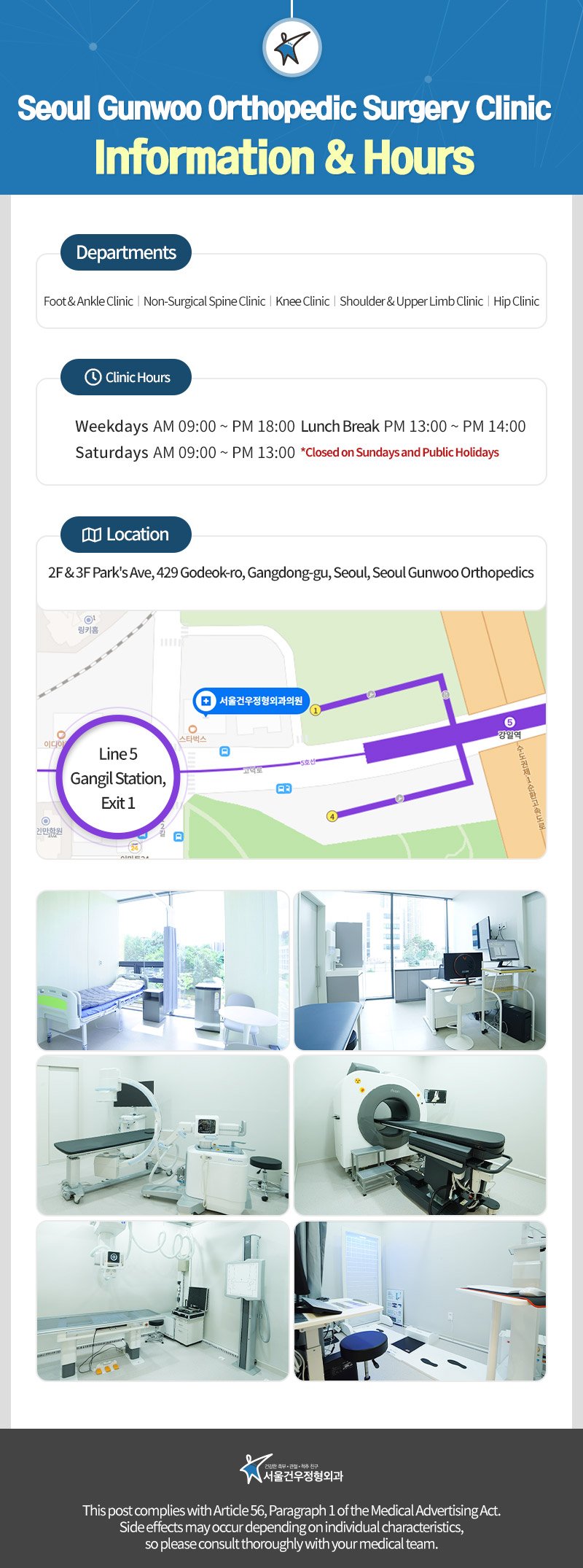
Q.Where is Seoul Gunwoo Orthopedic Surgery Clinic, and how can I contact it?
A.The clinic is at 2F-3F, 429, Godeok-ro, Gangdong-gu, Seoul, Republic of Korea. Call 02-426-9876 to ask about booking.
Clinic Information
| Clinic | Seoul Gunwoo Orthopedic Surgery Clinic |
|---|---|
| Specialty | Orthopedics |
| Address | 2F-3F, 429, Godeok-ro, Gangdong-gu, Seoul, Republic of Korea |
| Phone | 02-426-9876 |
| Website | https://seoulfoot.sillajewelry.com |
| Specialist | Specialist care |
 Seoul Gunwoo Orthopedic Surgery Clinic