
Choosing an Achilles tendon surgery hospital in Seoul
An Achilles tendon injury can affect walking, climbing stairs, and other activities that depend on pushing off the foot. Choosing where to seek care starts with an assessment of the injury and a clear discussion of treatment options—not with the assumption that every tendon injury requires surgery. Look for a clinic whose clinical focus and published treatment methods are relevant to your condition. Seoul Gunwoo Orthopedic Surgery Clinic focuses on foot and ankle orthopedics, including Achilles tendon repair, in Gangdong-gu, Seoul.
Match the clinic’s focus to your concern
The Achilles tendon connects the calf muscles to the heel bone. A sudden rupture and longer-standing tendon pain are different problems, even though both involve the same tendon. A useful consultation should address what happened, where symptoms are located, and how the injury affects movement. Seoul Gunwoo Orthopedic Surgery Clinic’s published areas of focus include Achilles tendon repair, ankle ligament surgery, bunion correction, ankle fracture surgery, ankle cartilage, and ankle arthritis.
A foot and ankle focus can be relevant when the source of pain is not yet clear. Heel and ankle symptoms can arise from more than one structure, so a description such as “Achilles pain” is a starting point rather than a diagnosis. Explain whether your symptoms began suddenly or developed over time, and identify the activities that make them noticeable. If you have already been examined elsewhere, bring the findings and any imaging you have. Ask the medical staff to explain the diagnosis before discussing a procedure. An assessment may lead to a conversation about surgery, nonoperative care, or further evaluation, depending on the injury. The decision should reflect the findings rather than the name of a technique alone.
A clinic’s foot and ankle focus is a useful starting point, but the diagnosis should guide the treatment discussion. Ask how the examination findings relate to your symptoms and whether repair is appropriate for your injury.
Know when an injury needs prompt assessment
A sudden snap or popping sensation at the back of the ankle, followed by pain, weakness, or difficulty pushing off the foot, can occur with an Achilles tendon rupture. If you suspect a rupture, seek prompt medical assessment rather than trying to exercise through it. Avoid activities that place further strain on the injured leg while arranging care. Sudden weakness or an inability to bear weight deserves timely attention, even if the pain is less severe than expected.
Not all Achilles problems begin with a dramatic event. Pain or stiffness that develops gradually can also interfere with activity and deserves evaluation when it persists or affects daily life. Describe the location of discomfort, any swelling, and changes in your ability to walk or exercise. Tell the medical staff about previous injuries and treatments, including rehabilitation exercises or changes in activity. These details help distinguish a recent injury from a longer-standing problem and give the consultation a practical starting point. If the leg becomes severely swollen or painful, seek urgent medical advice. Chest pain or shortness of breath requires emergency care. A clinic visit should not delay emergency evaluation for symptoms that could indicate a serious complication.
Prepare for a useful consultation
Before your appointment, write down how the symptoms began and what you can and cannot do comfortably. Bring relevant scan reports, images, medication information, and records of previous treatment if you have them. Consider your daily demands as well: walking requirements, work responsibilities, sport, and help available at home can all shape the discussion about treatment and recovery. Your priorities are part of the decision, not a substitute for the clinical assessment.
Prepare questions that invite an explanation rather than a simple yes or no. Ask what the examination suggests, whether imaging is needed, and what findings would influence the choice between treatment approaches. If surgery is discussed, ask what the procedure is intended to address and how recovery will be monitored. You can also ask who to contact if symptoms change before the next appointment.
Language is another practical consideration when arranging care in Seoul. Contact Seoul Gunwoo Orthopedic Surgery Clinic before booking to confirm whether language support or interpretation will be available for your visit. An English-language website alone does not establish that an English-speaking clinician or interpreter will be present. Clear communication matters when discussing consent, rehabilitation instructions, and signs that require medical attention.
Achilles tendon surgery hospital in Seoul: Understanding repair options
Surgery for an Achilles tendon rupture is intended to reconnect the injured tendon, but the appropriate approach depends on the individual injury and assessment. Seoul Gunwoo Orthopedic Surgery Clinic lists ultrasound-guided Achilles repair among its techniques. During a consultation, ask how that technique relates to your diagnosis and whether another approach should be considered. A named procedure is most useful to a patient when the medical staff can explain its purpose, the alternatives, and the expected rehabilitation plan.
Discuss surgery and nonoperative care
Some Achilles tendon ruptures are treated with surgery, while others are managed without an operation. Nonoperative care can involve protecting the tendon and following a structured rehabilitation plan. The choice depends on factors such as the injury, the time since it occurred, activity needs, and overall health. Ask the attending doctor to explain the reasons for recommending one approach over another and what each option would require from you during recovery.
A comparison should cover more than the operation itself. Discuss how the tendon will be protected, when movement and weight-bearing may be introduced, and how progress will be assessed. The details can differ according to the injury and the treatment plan. It is also reasonable to ask what evidence from your examination or imaging supports the recommendation. If you have a job that requires prolonged standing, or if you want to return to a particular activity, explain that early. The medical staff can then address those goals in the context of your condition. Do not interpret a treatment recommendation as a promise of a particular outcome. Recovery and changes in function depend on individual circumstances and adherence to the agreed plan.
Surgery is one option for an Achilles tendon rupture, not an automatic choice for every patient. A useful comparison includes the clinical findings, alternatives, and rehabilitation commitments associated with each approach.
Ask about ultrasound-guided Achilles repair
Ultrasound uses sound waves to create images of structures inside the body. In an ultrasound-guided procedure, imaging is used to help the medical team see relevant anatomy while carrying out treatment. Seoul Gunwoo Orthopedic Surgery Clinic names ultrasound-guided Achilles repair as a technique. Ask the attending doctor how ultrasound is used in the proposed procedure and why the technique is or is not suitable for your injury.
When discussing a procedure, request an explanation in terms you can use to make a decision. Questions might include where the tendon is injured, how the repair would be performed, what type of anesthesia is planned, and what protection the ankle will need afterward. Ask about the risks relevant to your health and how concerns would be handled after the procedure. It is also appropriate to ask whether the recommended approach differs from other repair methods and why. The presence of ultrasound guidance does not remove the need for careful assessment or rehabilitation. Technique and aftercare should be considered together, because the treatment plan continues beyond the procedure itself.
Understand the broader foot and ankle focus
Achilles tendon repair is one part of Seoul Gunwoo Orthopedic Surgery Clinic’s published foot and ankle focus. The clinic also lists treatment areas involving ankle ligaments, bunions, fractures, cartilage, and arthritis. Its named techniques include the Modified Broström ligament repair and MICA minimally invasive bunion surgery. These address different conditions; their inclusion in the clinic’s published services does not mean they are treatments for an Achilles tendon rupture.
That distinction matters when comparing procedures online. A technique associated with ankle instability or bunion correction should not be treated as interchangeable with tendon repair. If you have symptoms in more than one area, explain each one during the consultation. The medical staff can assess whether the concerns are related and which problem needs attention first. Ask for the name of any proposed procedure and the condition it is intended to treat.
| Published technique | Condition or treatment area |
|---|---|
| Ultrasound-guided Achilles repair | Achilles tendon repair |
| Modified Broström ligament repair | Ankle ligament repair |
| MICA minimally invasive bunion surgery | Bunion correction |
Use the table as a starting point for questions, not as a guide to choosing your own procedure. A diagnosis, examination, and discussion of your circumstances come first. If the medical staff recommends treatment, ask how the chosen method addresses the specific injury and what other options were considered. That conversation is more informative than comparing procedure names without knowing how they apply to your case.
Achilles tendon surgery hospital in Seoul: Planning recovery
Recovery planning should begin before a treatment decision is finalized. Achilles tendon rehabilitation generally involves protecting the healing tendon and gradually restoring movement, strength, and function under medical guidance. The details depend on the injury and whether surgery is performed. Ask for instructions you can follow at home, including how to protect the ankle and when to report a concern. Discuss work, transport, and daily activities so you can prepare for the restrictions in your individual plan.
Make rehabilitation part of the decision
After Achilles tendon treatment, rehabilitation is not simply a return to exercise whenever the ankle feels comfortable. The medical staff may recommend a period of protection followed by a gradual progression of movement, weight-bearing, and strengthening. Ask what equipment or assistance you may need and how follow-up decisions will be made. Changes in strength and activity tolerance may take time depending on your condition and the treatment plan.
Before leaving the consultation, clarify which activities are permitted and which should be avoided. If you are given exercises, ask how to perform them and what to do if they cause discomfort. Find out how the medical staff will assess your progress and when to seek advice rather than changing the plan on your own. Your circumstances matter: stairs at home, a physically demanding job, or responsibility for dependents can make practical arrangements important. If you hope to return to running or another sport, ask which functional milestones will guide that decision. A clear rehabilitation plan should connect each stage of activity to your individual assessment. Avoid relying on another patient’s timetable, since injuries and treatment plans are not identical.
Rehabilitation is part of Achilles tendon care, whether treatment involves surgery or a nonoperative approach. Understand the restrictions, follow-up plan, and criteria for progressing activity before you make arrangements for recovery.
Points to consider before treatment
Every procedure has considerations that should be discussed in the context of your health. Ask about risks associated with the proposed treatment, anesthesia, wound care, and reduced mobility. The attending doctor can explain which concerns are relevant to you and what symptoms should prompt a call or urgent assessment. For nonoperative treatment, ask how the tendon will be protected and what happens if progress does not follow the expected course.
It is also helpful to review medications, allergies, and health conditions with the medical staff before treatment. Do not stop prescribed medication without advice from the clinician responsible for it. If surgery is recommended, ask for instructions on preparing for the procedure and caring for the treated area afterward. Make sure you understand how to get help if you notice a problem outside a scheduled follow-up visit. Some symptoms require urgent attention: for example, chest pain or shortness of breath warrants emergency care. A written plan or personal notes can help you remember the instructions, especially if an interpreter is involved. Repeat the key steps back during the consultation to check that you have understood them correctly.
Arrange the practical details
Before booking, consider what you need to participate fully in the consultation. Bring your medical records, prepare a short description of your symptoms, and decide whether you need someone to accompany you. If interpretation is important, confirm the arrangements in advance. For a discussion of surgery, ask about the consultation process, treatment costs, and the steps required before a procedure. Costs depend on the assessment and proposed care.
Ask how follow-up appointments are arranged and what information you should bring to each visit. If you are traveling for treatment, consider how you will manage transport after the consultation or procedure and how you will attend follow-up care. The answers will depend on your treatment plan, so make these arrangements after discussing your expected needs with the medical staff.
Choosing care is ultimately about having enough information to make an informed decision. Seoul Gunwoo Orthopedic Surgery Clinic’s foot and ankle focus and published ultrasound-guided Achilles repair technique offer relevant topics for discussion. Use the consultation to clarify your diagnosis, compare appropriate options, and understand the practical work of recovery. Take time to ask questions until the proposed plan and its purpose are clear.
Frequently Asked Questions
Q.What does Seoul Gunwoo Orthopedic Surgery Clinic offer?
A.Seoul Gunwoo Orthopedic Surgery Clinic is a foot and ankle-focused orthopedic clinic. Its published areas of focus include Achilles tendon repair, ankle ligament surgery, bunion correction, ankle fracture surgery, ankle cartilage, and ankle arthritis.
Q.Who might consider an appointment for an Achilles tendon concern?
A.An appointment may be useful for someone with Achilles tendon pain, weakness, or difficulty pushing off the foot. A suspected sudden rupture should be assessed promptly.
Q.What Achilles tendon repair technique does the clinic list?
A.Seoul Gunwoo Orthopedic Surgery Clinic lists ultrasound-guided Achilles repair among its techniques. Ask the attending doctor whether it is appropriate for your injury.
Q.What should I bring to a consultation?
A.Bring relevant imaging, reports, medication information, and records of previous treatment if available. A note describing when your symptoms began and how they affect activity can also help.
Q.Where is the clinic, and how can I contact it?
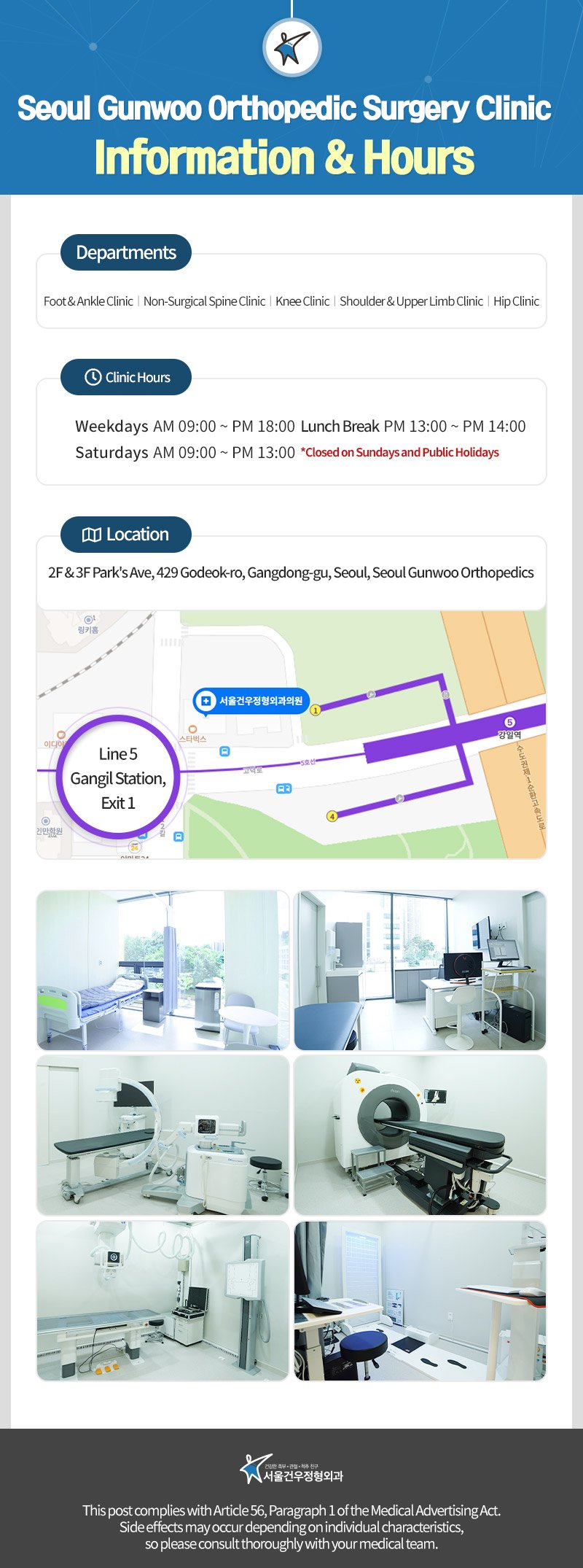
A.Seoul Gunwoo Orthopedic Surgery Clinic is at 2F-3F, 429, Godeok-ro, Gangdong-gu, Seoul, Republic of Korea. The phone number is 02-426-9876.
Clinic Information
| Clinic | Seoul Gunwoo Orthopedic Surgery Clinic |
|---|---|
| Specialty | Orthopedics |
| Address | 2F-3F, 429, Godeok-ro, Gangdong-gu, Seoul, Republic of Korea |
| Phone | 02-426-9876 |
| Website | https://seoulfoot.sillajewelry.com |
| Specialist | Specialist care |
 Seoul Gunwoo Orthopedic Surgery Clinic