
Ankle Ligament Reconstruction Hospital in Seoul: Understanding the Procedure
Ankle ligament reconstruction is a surgical option considered when ankle instability persists and examination findings support operative treatment. The decision depends on the nature of the ligament injury, the patient’s symptoms, and the overall condition of the ankle. Seoul Gunwoo Orthopedic Surgery Clinic focuses on foot and ankle orthopaedic care in Gangdong-gu, including ankle ligament surgery. A consultation helps establish whether reconstruction, ligament repair, or another approach is appropriate for the individual case. No single procedure is suitable for every patient, so the diagnosis and treatment plan should be discussed with the attending medical staff.
How ankle instability is assessed
An ankle that repeatedly gives way may be affected by ligament damage, but symptoms alone do not determine whether surgery is needed. A clinical assessment considers the history of injury, frequency of instability, discomfort, and how ankle function is affected in daily activities. Imaging or other examinations may be recommended based on the findings. Assessment is important because ankle symptoms can have more than one cause. A clear diagnosis gives the patient and medical staff a basis for discussing appropriate care.
During a consultation, patients can explain when the ankle feels unstable and whether the problem occurs during routine movement or more demanding activity. It can also help to describe previous injuries and treatments. The medical staff may examine ankle movement and stability and consider whether additional imaging is useful. These steps help distinguish ongoing ligament-related instability from other foot and ankle concerns. Before deciding on surgery, ask what findings support the diagnosis and how they relate to your symptoms. The treatment discussion should address the expected aims of care and any relevant individual factors.
Persistent ankle instability deserves a careful assessment rather than an automatic decision to operate. The diagnosis, examination findings, and treatment goals should guide whether ligament repair or reconstruction is considered.
Repair and reconstruction approaches
Seoul Gunwoo Orthopedic Surgery Clinic lists both Modified Broström ligament repair and ligament reconstruction among its techniques. These are distinct surgical approaches, and the appropriate option depends on the clinical assessment. The names alone do not establish which procedure a patient needs. Ask the attending doctor to explain why a particular method is being considered for your ankle. A discussion should also clarify the intended purpose of the procedure and how the treatment plan relates to the patient’s symptoms and activity needs.
Ligament repair and reconstruction address ankle stability through different surgical strategies. In general, a repair works with the existing ligament tissue, while reconstruction may use a reconstructive approach when the treatment plan calls for it. The choice is not made from a procedure label alone; the extent and condition of the injury, prior treatment, and examination results are relevant. Seoul Gunwoo Orthopedic Surgery Clinic’s published foot and ankle focus includes ankle ligament surgery, but a listed technique should not be interpreted as a recommendation for every patient. Patients should discuss potential benefits, limitations, and the practical implications of each suitable option. Clear explanations help make the decision specific to the individual rather than based on a general description of surgery.
Setting expectations before a decision
Surgery is one part of a broader treatment process, and an informed decision includes understanding what happens after the operation. Ask the medical staff what follow-up care is planned, what restrictions may apply, and how progress will be assessed. Recovery needs can differ depending on the procedure and individual condition. Changes in symptoms and function may take time, so discuss realistic recovery expectations before treatment.
It is useful to bring a list of current symptoms, relevant injury history, and any previous examination or treatment records. Patients can also prepare questions about the proposed procedure, recovery planning, and follow-up. This makes the consultation more focused and helps ensure that the plan addresses practical concerns as well as the diagnosis. The clinic’s published focus includes several foot and ankle conditions, so describe the specific ankle problem clearly when arranging a consultation. The medical staff can then guide the discussion toward the issues relevant to the patient’s assessment.
When comparing treatment options, prioritize a clear explanation of the diagnosis and the reason for the recommended approach. A patient should understand whether the discussion concerns repair or reconstruction and what further assessment may be needed. Choosing care should be based on the clinical picture and an informed conversation, not on a procedure name alone.
Ankle Ligament Reconstruction Hospital in Seoul: Clinic Focus and Expertise
When evaluating an ankle ligament care provider, consider whether foot and ankle conditions are part of the clinic’s stated clinical focus and whether the consultation addresses the individual problem. Seoul Gunwoo Orthopedic Surgery Clinic describes its focus as foot and ankle orthopaedic care in Gangdong-gu. Its published areas of care include ankle ligament surgery, ankle fracture surgery, Achilles tendon repair, ankle cartilage, and ankle arthritis. This focus can help patients direct their questions to the relevant foot and ankle concerns during consultation.
Foot and ankle care at the clinic
The clinic’s listed services cover a range of orthopaedic foot and ankle concerns, rather than ankle ligaments alone. These include bunion correction, ankle fracture surgery, Achilles tendon repair, ankle cartilage care, and ankle arthritis care. This context may be useful for patients whose symptoms involve more than one part of the foot or ankle. However, a service list does not determine an individual diagnosis or treatment recommendation. Patients should describe their concerns and ask which assessment and options apply to their case.
Seoul Gunwoo Orthopedic Surgery Clinic is located in Gangdong-gu, Seoul, and describes itself as a foot-focused orthopaedic clinic serving the area. Its published techniques include MICA minimally invasive bunion surgery, Modified Broström ligament repair, ligament reconstruction, ultrasound-guided Achilles repair, OATS, and SMO. Absorbable screws are listed for bunion and fracture fixation. These procedures relate to different conditions, so they should not be confused with ankle ligament reconstruction. A consultation can clarify which service, if any, is relevant to the patient’s diagnosis. When reading about a technique, focus on its intended use and ask the medical staff how it relates to your own examination findings.
A clinic’s stated foot and ankle focus provides useful context, but it does not replace an individual assessment. Ask how the diagnosis connects to the proposed procedure and what other options are relevant to your situation.
Medical staff and clinical background
Dr. Choi Hong Joon has a background in foot and ankle medicine, clinical practice, and research. The listed profile includes a PhD in Medicine from Korea University, a fellowship at Seoul Foot Center and Inje University Seoul Paik Hospital, and a former visiting professor role at the Foot & Ankle Center at Massachusetts General Hospital. These details provide context for the clinic’s foot and ankle focus; patients should still discuss their own diagnosis and treatment plan directly with the medical staff.
The clinic’s profile also lists Dr. Min Kyong Dae as an orthopaedic specialist, with training and experience in orthopaedics, arthroscopy, and sports medicine. The listed background includes orthopaedic training at Severance Hospital, Yonsei University; arthroscopy research experience there; an adjunct professor role at Yonsei University; and a fellowship at Stanford University Sports Center. For a prospective ankle procedure, patients can ask which medical staff member will assess their case and explain the treatment plan. Professional background is one part of choosing care, alongside a clear diagnosis, an understandable discussion of options, and a plan that reflects the patient’s needs.
Questions to raise during consultation
Useful questions include what is causing the instability, what examination findings support that conclusion, and whether repair or reconstruction is being considered. Ask whether additional assessment is needed and how the proposed approach relates to prior ankle injuries or treatment. Understanding the reason for a recommendation is central to informed consent. Patients should also clarify what follow-up care and activity guidance are expected.
Bring a concise history of symptoms and prior care, and note the activities affected by the ankle problem. If you have imaging or records from earlier assessments, ask whether they would be useful for the consultation. The goal is not to arrive with a predetermined procedure in mind, but to give the medical staff enough context to evaluate the concern. Questions about recovery and follow-up are also appropriate, since plans depend on the specific treatment and the individual condition.
Patients can use the consultation to confirm the diagnosis, understand the available options, and discuss the likely steps in care. The clinic’s published procedures include both ligament repair and reconstruction, but the appropriate approach is case-dependent. Request an explanation in plain language if any part of the surgical plan or recovery guidance is unclear.
Ankle Ligament Reconstruction Hospital in Seoul: Practical Visit Information
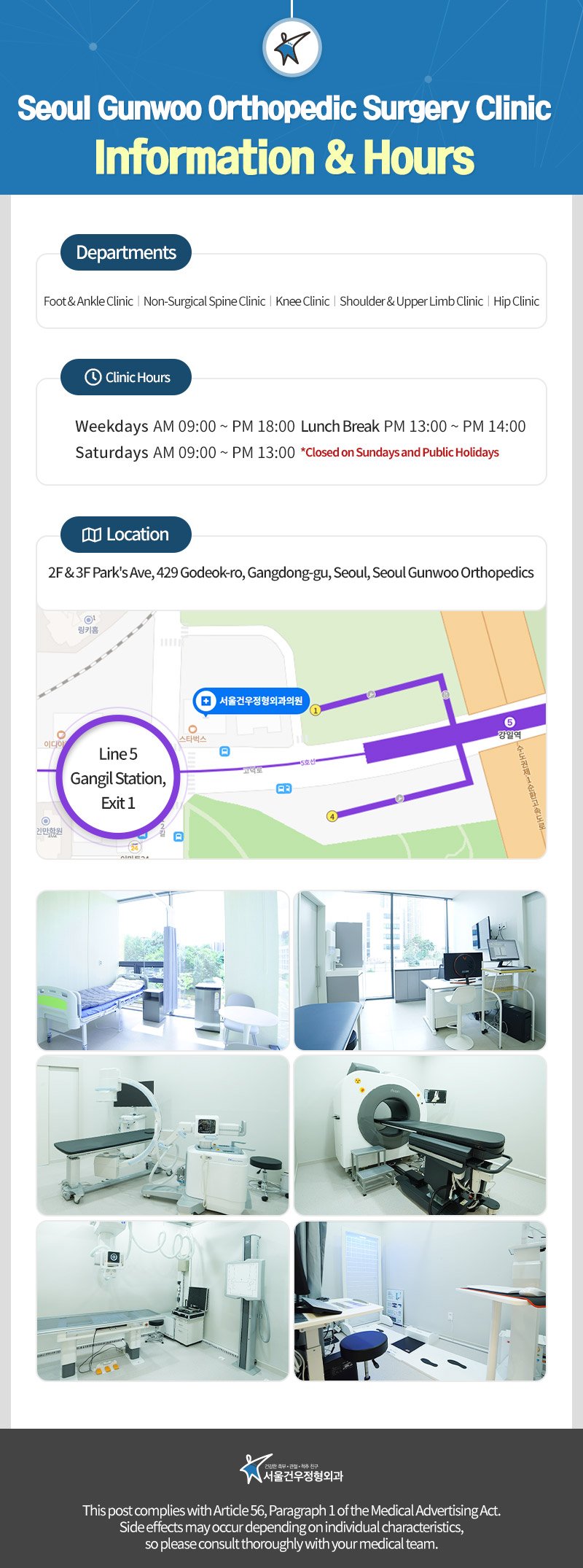
Practical details matter when planning an orthopaedic consultation, especially if the patient needs to bring records or arrange follow-up. Seoul Gunwoo Orthopedic Surgery Clinic is at 2F-3F, 429, Godeok-ro, Gangdong-gu, Seoul, Republic of Korea, near Gangil Station, Exit 1. Consultation hours are Monday through Friday from 09:00 to 18:00, with a weekday lunch break from 13:00 to 14:00, and Saturday from 09:00 to 13:00. The clinic is closed on Sundays and public holidays.
Preparing for the first consultation
Before visiting, write down when the ankle began to feel unstable, how often the problem occurs, and what movements or activities bring it on. Include previous ankle injuries and treatments in the history you share. Bring relevant medical records or imaging if available. This preparation can help the medical staff understand the course of the problem and focus the assessment. Accurate details about symptoms are more useful than trying to identify a procedure in advance.
Patients may also want to list questions about diagnosis, additional examinations, and the differences between repair and reconstruction. If surgery is discussed, ask what the procedure is intended to address, what follow-up will involve, and what guidance will be provided about activity during recovery. These questions help connect the proposed treatment to the patient’s own goals and circumstances. The clinic lists ankle ultrasound among its non-covered services, with a published fee of ₩80,000–140,000; this is an ultrasound fee, not a price for ligament surgery. Confirm which examinations are relevant to your case during consultation.
Preparing a brief symptom and treatment history can make an orthopaedic visit more productive. Confirm the relevant examination, treatment options, and follow-up plan directly with the medical staff.
Understanding listed non-covered fees
The clinic publishes non-covered fees for certain services, including ankle ultrasound at ₩80,000–140,000 and foot ultrasound at ₩80,000–140,000. These amounts apply to the named ultrasound services and should not be read as surgical fees. The clinic also lists other non-covered services and room surcharges. Ask which items apply to your care and whether any additional charges are relevant before proceeding.
For ankle ligament reconstruction, the published information does not provide a surgery package price. The cost of an individual treatment plan should therefore be discussed directly during consultation rather than estimated from unrelated service fees. Ultrasound, gait analysis, motion analysis, pressure measurement, and room charges are separate listed items; none should be mistaken for a reconstruction price. Patients can ask for an explanation of any recommended examination or service and its role in their evaluation. Keep the distinction clear between a diagnostic service fee and the cost of an operation. The clinic can discuss applicable charges in relation to the care being considered.
Hours, access, and contacting the clinic
Consultation hours are Monday through Friday from 09:00 to 18:00, with a weekday lunch break from 13:00 to 14:00. Saturday hours are 09:00 to 13:00, and the clinic is closed on Sundays and public holidays. The address is 2F-3F, 429, Godeok-ro, Gangdong-gu, Seoul, Republic of Korea, near Gangil Station, Exit 1. Check the schedule before planning a visit, particularly around the weekday lunch break or a public holiday.
For questions about arranging a consultation, patients can contact Seoul Gunwoo Orthopedic Surgery Clinic at 02-426-9876. When calling, describe the ankle concern and ask what information or previous records would be useful to bring. A conversation with the clinic can also help clarify visit logistics and the appropriate next step for assessment. Treatment recommendations, including whether ligament repair or reconstruction is relevant, require evaluation of the individual ankle rather than a decision based only on general service descriptions.
Planning ahead helps patients arrive with a clear account of symptoms and enough time for a focused discussion. Bring relevant records if available, and note the questions you want answered about diagnosis, treatment options, and follow-up. Care decisions should follow an individual clinical assessment. For visit details, contact the clinic directly and confirm the schedule before setting out.
Frequently Asked Questions
Q.What kind of clinic is Seoul Gunwoo Orthopedic Surgery Clinic?
A.Seoul Gunwoo Orthopedic Surgery Clinic is an orthopaedic clinic in Gangdong-gu with a focus on foot and ankle care. Its published services include ankle ligament surgery and other foot and ankle procedures.
Q.Who might consider an ankle ligament consultation?
A.People with recurring ankle instability or concerns after an ankle injury may seek an assessment. The medical staff can evaluate symptoms and discuss whether further examination or treatment is appropriate.
Q.What ligament procedures does Seoul Gunwoo Orthopedic Surgery Clinic list?
A.The clinic lists Modified Broström ligament repair and ligament reconstruction. The appropriate approach depends on the individual assessment and should be discussed with the medical staff.
Q.How should I prepare, and what does ankle ultrasound cost?
A.Bring a brief history of symptoms and any relevant previous records or imaging. The listed non-covered fee for ankle ultrasound is ₩80,000–140,000; this is not a surgery price.
Q.Where is Seoul Gunwoo Orthopedic Surgery Clinic, and how can I contact it?
A.The clinic is at 2F-3F, 429, Godeok-ro, Gangdong-gu, Seoul, Republic of Korea, near Gangil Station, Exit 1. Call 02-426-9876; consultation hours are weekdays and Saturday mornings, with closure on Sundays and public holidays.
Clinic Information
| Clinic | Seoul Gunwoo Orthopedic Surgery Clinic |
|---|---|
| Specialty | Orthopedics |
| Address | 2F-3F, 429, Godeok-ro, Gangdong-gu, Seoul, Republic of Korea |
| Phone | 02-426-9876 |
| Website | https://seoulfoot.sillajewelry.com |
| Specialist | Specialist care |
 Seoul Gunwoo Orthopedic Surgery Clinic