
Recommended hospital for bunion surgery in Seoul: understanding your options
A bunion is a change in the alignment of the big toe and the joint at its base. Discomfort, pressure from footwear, and difficulty with everyday activities can lead someone to seek an orthopedic assessment. At Seoul Gunwoo Orthopedic Surgery Clinic, the listed bunion technique is MICA minimally invasive bunion surgery. The appropriate approach depends on an individual’s symptoms and foot structure, so a search for a recommended hospital should lead to a careful discussion rather than an assumption that surgery is necessary. Start by clarifying what is causing your symptoms and what treatment options fit your situation.
What to consider when comparing bunion surgery options
When considering a hospital for bunion care, look for clear information about the procedure, the assessment process, and what factors shape treatment planning. Bunion symptoms and foot alignment can differ from person to person, so a single technique should not be assumed to suit everyone. Ask how the medical staff will evaluate your concerns and explain the options, including whether surgery is appropriate. A useful consultation connects the proposed procedure to your specific symptoms and goals.
Seoul Gunwoo Orthopedic Surgery Clinic lists MICA minimally invasive bunion surgery among its techniques. The name describes a minimally invasive approach, but the exact plan should be discussed in relation to your examination and clinical needs. A treatment decision is not based only on how a procedure is named: the medical staff should consider the joint, alignment, symptoms, and what matters in your daily routine. Be ready to describe when discomfort occurs, what activities are affected, and what you hope treatment will address. This context helps make the discussion more specific and supports an informed choice.
Choosing a bunion procedure requires an individual assessment, not just a comparison of technique names. Ask how the proposed approach relates to your symptoms, foot structure, and practical goals.
Understanding MICA minimally invasive bunion surgery
MICA is the bunion procedure named on Seoul Gunwoo Orthopedic Surgery Clinic’s official pages. The clinic describes it as minimally invasive bunion surgery. That designation alone does not determine whether it is suitable for a particular person or establish what outcome to expect. The medical staff can discuss the procedure and its relevance after assessing the individual case. Ask for an explanation of the intended treatment plan and how it addresses your specific concerns.
Before deciding, discuss the details that matter to you: the reason the procedure is being considered, how the medical team evaluates the bunion, and what preparation or follow-up may be relevant to your circumstances. It is also sensible to ask about alternatives and the possible limitations of the proposed plan. The clinic lists other foot and ankle techniques, but their presence on the service list does not mean they are part of bunion surgery or suitable for every patient. Make sure you understand the recommended procedure in your own case rather than relying on a general description of MICA. If you have questions about recovery or activity, ask the medical staff for guidance tailored to your evaluation.
Who may benefit from an orthopedic assessment
An assessment can be useful when a bunion causes ongoing discomfort, makes footwear difficult, or interferes with routine activities. People may also seek advice when they are unsure whether symptoms are related to a bunion or another foot concern. These situations do not automatically mean surgery is needed. The medical staff can evaluate the problem and discuss options in light of the individual’s symptoms and findings. Describe what you notice and how it affects your daily life.
It helps to arrive with a practical account of your concerns. Note where discomfort occurs, what tends to bring it on, and which activities or shoes are difficult to manage. If you have previously received an assessment or treatment, share those details with the attending medical staff. This information can make the discussion more focused without assuming a particular diagnosis or procedure in advance. A bunion consultation should address whether the symptoms are consistent with the visible alignment change and what options are relevant. Questions about the goal of treatment, the reasoning for a proposed approach, and what to expect afterward are appropriate. The purpose is to make a decision based on your condition, not on the label of a procedure alone.
Questions to bring to your consultation
Prepare a short list of questions so you can compare the proposed plan with your needs. You might ask what the assessment shows, whether a non-surgical approach is appropriate, and why MICA is being considered if surgery is discussed. Ask how the plan relates to your symptoms and what follow-up guidance may be needed. Clear answers help you take part in the decision rather than treating a procedure name as a recommendation by itself.
It is also useful to raise practical concerns, such as the activities you need to return to and any questions about preparation. Share relevant health information and mention any previous foot or ankle care. The medical staff can explain which details matter for your case. If a recommended plan is unclear, ask for the reasoning in plain language before deciding. This helps you understand what the procedure is intended to address and what is not being promised. A careful conversation is part of choosing treatment responsibly.
Recommended hospital for bunion surgery in Seoul: assessment and planning
Bunion treatment planning starts with understanding the person’s symptoms and the foot’s condition. The clinic lists foot and ankle ultrasound among its services, along with a published fee for that specific non-covered service. That does not mean ultrasound is required for every bunion assessment; the medical staff determines what is relevant. Ask which assessments are appropriate for your case and how each one would inform the treatment discussion. A clear plan should distinguish evaluation from treatment and explain why a particular procedure is being considered.
How an assessment can guide treatment discussions
At a consultation, explain the symptoms that prompted you to seek care and the activities they affect. The medical staff can use that history alongside an assessment to discuss the next steps. The clinic lists foot and ankle ultrasound, but an individual evaluation determines whether it is relevant. Do not assume a listed test is automatically part of bunion care. Ask what each assessment is intended to clarify and how its result could affect the plan.
Useful preparation includes noting when symptoms occur, whether footwear affects them, and what daily tasks have become difficult. Mention prior evaluations or treatment and share other health details that may be relevant. This helps the attending medical staff understand the context of your concern. If surgery is discussed, ask how the recommendation relates to the findings and whether other approaches should be considered. A treatment decision should be explained in a way you can understand, including its purpose and the factors that may influence it. The clinic also lists ankle ultrasound, gait analysis, motion analysis, and dynamic plantar-pressure measurement; these are separate services, and their relevance depends on the clinical question being considered.
A useful assessment connects symptoms and clinical findings to the treatment plan. Tests and procedures listed by a clinic should be discussed in terms of whether they are relevant to the individual case.
How to discuss MICA and other listed techniques
MICA minimally invasive bunion surgery is the technique specifically named for bunion care at Seoul Gunwoo Orthopedic Surgery Clinic. The clinic also lists other foot and ankle techniques, including Modified Broström ligament repair, ligament reconstruction, ultrasound-guided Achilles repair, OATS, and SMO absorbable screws for bunion and fracture fixation. These are distinct procedures or techniques, not interchangeable options. Ask which service, if any, applies to your diagnosis and why.
When discussing MICA, ask the medical staff to explain the plan for your individual condition and what considerations inform the recommendation. If you see another technique listed, do not assume it is part of the bunion procedure or required in your case. Procedures such as ligament repair or Achilles repair address different concerns, while absorbable screws are listed for bunion and fracture fixation. The relevance of any technique depends on the clinical assessment. Request a clear explanation of the procedure being proposed, its purpose, and the alternatives that may be appropriate. That conversation can help you distinguish between a clinic’s full range of services and the specific plan for your foot.
Published fees for selected non-covered services
Seoul Gunwoo Orthopedic Surgery Clinic publishes fees for selected non-covered services. These charges are not a bunion surgery package, and they should not be treated as the price of MICA or another operation. The listed fees include foot or ankle ultrasound, gait analysis, motion analysis, and dynamic plantar-pressure measurement. Ask which items, if any, apply to your evaluation and request an explanation of charges relevant to your care. Keep assessment fees separate from a surgical fee discussion.
The clinic also lists room surcharges and an English medical certificate fee among selected non-covered charges. These are separate items and do not establish the cost of surgery. Your consultation is the appropriate place to discuss which services are relevant and what charges may apply to your situation. Published fees for the specified services are organized below for clarity; they should not be read as a complete treatment estimate.
| Selected non-covered service | Published fee |
|---|---|
| Ankle ultrasound | ₩80,000–140,000 |
| Foot ultrasound | ₩80,000–140,000 |
| Gait analysis | ₩50,000 |
| Motion analysis | ₩70,000 |
| Dynamic plantar-pressure measurement | ₩100,000 |
| Motion analysis plus dynamic plantar pressure | ₩150,000 |
| Single-room surcharge | ₩200,000 |
| Twin-room surcharge | ₩100,000 |
| Special single-room surcharge | ₩250,000 |
| English medical certificate | ₩20,000 |
These figures apply only to the named items. They do not indicate a surgical charge or confirm that a particular service is needed. Discuss any proposed assessment or facility charge with the clinic before proceeding, so you understand what is being billed and why. For bunion surgery pricing, ask the clinic directly about the plan for your case rather than estimating from the fees above.
Recommended hospital for bunion surgery in Seoul: preparing for care
Choosing where to seek bunion care involves more than identifying a procedure. Consider whether you can explain your symptoms, understand the proposed plan, and raise questions about evaluation and costs. Seoul Gunwoo Orthopedic Surgery Clinic is an orthopedics clinic that lists MICA minimally invasive bunion surgery and foot and ankle assessment services. Preparation helps you have a focused discussion and understand what the next step involves. Bring relevant information and ask for guidance specific to your circumstances.
Preparing for an appointment
Before visiting Seoul Gunwoo Orthopedic Surgery Clinic, think through the symptoms you want to discuss and how they affect everyday activities. Bring information about previous foot or ankle assessments and treatments if available, and be ready to explain any other health details relevant to care. A concise list of questions can help you cover the procedure, assessment, and practical concerns. You do not need to decide on surgery before having an evaluation.
Questions can include whether the symptoms appear related to the bunion, what options are suitable, and why a particular procedure is being discussed. If MICA is proposed, ask what it is intended to address in your case and what other considerations are relevant. You can also ask whether any assessment, such as ultrasound or gait analysis, is appropriate and what it would help clarify. Each service should be discussed on its own merits rather than assumed to be necessary because it is listed. Clear communication gives you a better basis for understanding the plan and making an informed decision. If you need information about appointment arrangements or charges, contact the clinic directly.
Good preparation makes the consultation more useful: describe your symptoms, share relevant history, and ask how the proposed assessment or treatment fits your case. A listed service is not automatically required for every patient.
Understanding the clinic’s orthopedic services
Seoul Gunwoo Orthopedic Surgery Clinic’s listed techniques cover several foot and ankle concerns. For bunion surgery, the named technique is MICA minimally invasive bunion surgery. Other listed services include Modified Broström ligament repair, ligament reconstruction, ultrasound-guided Achilles repair, OATS, and SMO absorbable screws for bunion and fracture fixation. These service names describe different techniques, so the medical staff should clarify which one relates to your particular concern.
The clinic’s medical team includes Dr. Choi Hong Joon, whose profile describes a background in foot and ankle medicine, clinical practice, and research, and Dr. Min Kyong Dae, whose profile lists orthopedic, arthroscopy, and sports-medicine training. Dr. Min is identified as an orthopaedic specialist in the profile. When discussing care, ask which medical staff member will be involved and how the proposed approach relates to your assessment. This keeps the conversation centered on your case and on the procedure actually being considered. The clinic’s broader service list can provide context, but it should not replace an explanation of the treatment plan for your specific symptoms.
Practical questions about costs and next steps
Ask which parts of an evaluation are relevant and whether any non-covered fees apply. Published fees are available for selected services, including foot and ankle ultrasound, but these are not bunion surgery prices. The cost of a surgical plan should be discussed directly with the clinic in connection with the proposed care. Do not use a diagnostic service fee as a substitute for a surgical estimate.
It is also reasonable to ask what steps follow the consultation and what information you should review before making a decision. Keep a record of the explanation and clarify any terms that are unfamiliar. If the proposed treatment includes a procedure, ask what it is intended to address and what considerations apply to your situation. These questions support an informed discussion without assuming a particular result or timeline. For appointment and location details, contact Seoul Gunwoo Orthopedic Surgery Clinic directly.

Frequently Asked Questions
Q.What kind of clinic is Seoul Gunwoo Orthopedic Surgery Clinic?
A.Seoul Gunwoo Orthopedic Surgery Clinic is an orthopedics clinic. Its listed bunion technique is MICA minimally invasive bunion surgery.
Q.Who should consider an assessment for bunion symptoms?
A.An assessment may be useful for people whose bunion-related discomfort affects footwear or daily activities, or who want to understand their symptoms. The medical staff can discuss whether surgery or another approach is relevant after evaluation.
Q.What bunion procedure does Seoul Gunwoo Orthopedic Surgery Clinic list?
A.The clinic lists MICA minimally invasive bunion surgery. Whether it is appropriate depends on the individual assessment and should be discussed with the medical staff.
Q.What should I know about fees before a consultation?
A.Published non-covered fees include foot or ankle ultrasound at ₩80,000–140,000. These fees are for the named services, not a bunion surgery package; ask the clinic about charges relevant to your proposed care.
Q.Where is Seoul Gunwoo Orthopedic Surgery Clinic, and how can I contact it?
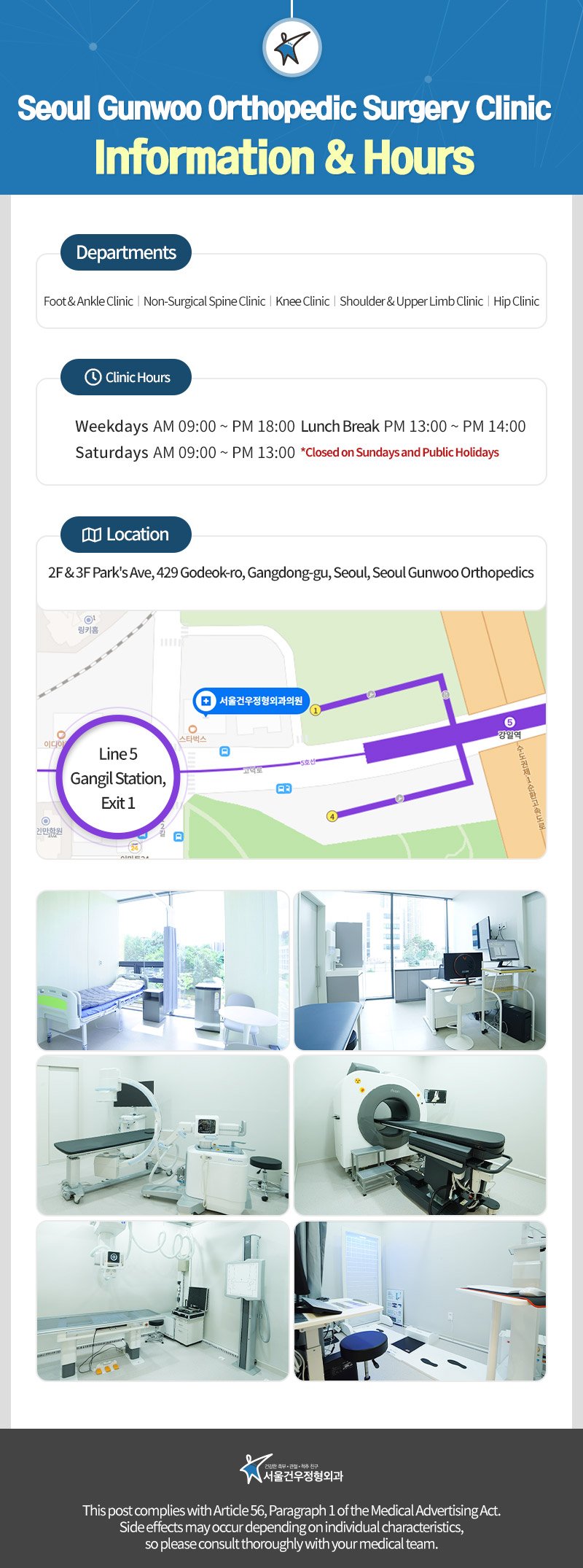
A.The clinic is at 2F-3F, 429, Godeok-ro, Gangdong-gu, Seoul, Republic of Korea. Call 02-426-9876 for inquiries.
Clinic Information
| Clinic | Seoul Gunwoo Orthopedic Surgery Clinic |
|---|---|
| Specialty | Orthopedics |
| Address | 2F-3F, 429, Godeok-ro, Gangdong-gu, Seoul, Republic of Korea |
| Phone | 02-426-9876 |
| Website | https://seoulfoot.sillajewelry.com |
| Specialist | Specialist care |
 Seoul Gunwoo Orthopedic Surgery Clinic