
Recommended Foot and Ankle Specialist in Seoul: Understanding the Focus
Foot and ankle problems can affect standing, walking, exercise, and everyday footwear choices. A useful orthopedic assessment looks beyond the location of pain to consider the structures involved and the activities affected. Seoul Gunwoo Orthopedic Surgery Clinic focuses on foot and ankle conditions, including bunions, ankle ligament injuries, fractures, Achilles tendon problems, cartilage conditions, and ankle arthritis. The appropriate treatment depends on the diagnosis, symptoms, and individual circumstances.
Why the Foot and Ankle Need Careful Assessment
The foot and ankle contain bones, joints, ligaments, tendons, and cartilage that work together to support movement. An injury to one structure can affect how the surrounding area functions. For example, an ankle that feels unstable after a sprain may require a different assessment from an ankle that is painful and stiff during ordinary walking. Describing when symptoms began and which activities bring them on gives the medical staff a starting point for the evaluation.
Symptoms can also change over time. A recent injury may cause swelling and difficulty bearing weight, while a longer-standing condition may become noticeable mainly during exercise or when wearing certain shoes. Neither pattern alone establishes a diagnosis. The attending doctor can consider the history and physical findings together and decide whether further assessment is appropriate. Be specific about how the problem affects daily activities, rather than describing its severity alone. Mention any previous ankle sprains, fractures, or treatment, as well as whether symptoms have improved, returned, or changed. This information helps make the consultation more focused and gives the medical staff context for discussing possible causes and next steps.
Foot and ankle care starts with identifying the structure involved and understanding how symptoms affect movement. A clear description of the problem helps guide the assessment and the discussion of treatment.
Conditions Within Our Clinic’s Published Focus
Our clinic’s published focus includes bunion correction, ankle ligament surgery, ankle fracture surgery, Achilles tendon repair, ankle cartilage conditions, and ankle arthritis. These areas involve different tissues and may call for different approaches. A bunion affects the alignment of the big toe, for example, while an ankle ligament injury concerns structures that help support the joint. An examination is needed to distinguish the cause of a particular symptom and discuss suitable care.
For patients, the practical distinction is not simply whether a condition has a familiar name. It is whether the problem is affecting comfort, stability, mobility, or the ability to return to usual activities. Someone with a bunion might want to discuss discomfort in footwear, while someone with an ankle injury might be concerned about repeated giving way. A person with ankle arthritis may wish to discuss pain or stiffness that affects walking. These concerns provide useful context, but a symptom does not by itself determine which treatment is appropriate. Our clinic can discuss the findings and explain the options relevant to the individual diagnosis.
Matching the Consultation to Your Concerns
Before a visit, consider what you most want to understand. You might ask what is causing the pain, whether a previous injury is related to current instability, or which options are relevant to your diagnosis. If you have received treatment elsewhere, bring any records or imaging you already have available. A concise account of your symptoms and prior care can help the attending doctor understand the course of the problem.
It is also useful to explain your routine. Work that involves prolonged standing, exercise, and footwear preferences can all affect the questions you bring to a consultation. The goal is not to choose a procedure before an examination. Instead, use the visit to understand the condition and the reasoning behind any proposed treatment, including what the treatment is intended to address.
| Area of focus | Examples of concerns to discuss |
|---|---|
| Bunions | Big-toe alignment and footwear discomfort |
| Ankle ligaments | Previous sprains and feelings of instability |
| Ankle fractures | Injury history and difficulty bearing weight |
| Achilles tendon | Symptoms around the back of the ankle and injury history |
| Ankle cartilage and arthritis | Pain, stiffness, and effects on walking |
The examples above are starting points for a conversation, not a substitute for diagnosis. Similar complaints can arise from different conditions, and more than one structure can be involved. If an injury is associated with an obvious deformity, an open wound, loss of sensation, or an inability to bear weight, seek prompt medical attention rather than waiting for a routine consultation.
Recommended Foot and Ankle Specialist in Seoul: Treatment Techniques
Seoul Gunwoo Orthopedic Surgery Clinic names several techniques on its official pages, including minimally invasive bunion surgery, ankle ligament repair and reconstruction, ultrasound-guided Achilles repair, and procedures referred to as OATS and SMO. Absorbable screws are also listed for bunion and fracture fixation. A technique being available or described does not mean it is suitable for every patient. The attending doctor can explain whether an approach is relevant after assessing the condition.
Bunion Correction and Fixation
A bunion, also called hallux valgus, involves a change in the alignment of the big toe. People may seek an assessment because of discomfort around the joint, difficulty finding comfortable footwear, or changes in toe position. Our clinic names MICA minimally invasive bunion surgery among its techniques. The discussion should begin with the symptoms and examination findings, not with the assumption that surgery is necessary.
If surgery is considered, ask the attending doctor to explain the intended correction, the technique being proposed, and why it fits your circumstances. Our clinic also lists absorbable screws for bunion and fracture fixation. Fixation is used to hold bone in position when required by a procedure; the choice of material and method depends on the treatment plan. Questions about the incision, expected recovery, footwear, and follow-up can help you understand what the proposed approach would involve. Changes in comfort or function may take time, depending on the individual condition and treatment. A consultation is the appropriate setting to discuss expectations without assuming a particular outcome.
Our clinic describes specific surgical techniques, but the diagnosis comes first. Ask how a proposed method addresses your condition and what recovery would involve for you.
Ankle Ligament Repair and Reconstruction
Ankle ligaments help support the joint. After an injury, some people experience ongoing symptoms or a feeling that the ankle may give way. Our clinic names the Modified Broström ligament repair and ligament reconstruction among its techniques. These procedures are distinct approaches, and their relevance depends on the injury, examination findings, and individual circumstances.
When discussing an ankle that feels unstable, describe how the original injury happened, whether the ankle has given way again, and which movements bring on symptoms. If you have previously used a brace or undertaken rehabilitation, explain what you tried and how the ankle responded. The attending doctor can assess the problem and discuss whether further care is appropriate. If a procedure is proposed, ask which ligament structures are involved, what the operation is intended to address, and how rehabilitation and follow-up fit into the plan. Understanding those details can help you make an informed decision without treating the name of a technique as a promise of a particular result.
Achilles Tendon and Cartilage Procedures
Our clinic names ultrasound-guided Achilles repair among its techniques and includes Achilles tendon repair in its published focus. Ultrasound guidance is a feature to discuss with the attending doctor when considering the proposed procedure. The nature of an Achilles problem, its timing, and the examination findings matter when deciding what care is appropriate. Explain when symptoms began and whether an injury occurred during a specific activity.
Our clinic also lists OATS and SMO among its techniques and identifies ankle cartilage and ankle arthritis as areas of focus. If one of these procedures is discussed, ask the attending doctor to explain the condition it is intended to address, why the technique is being considered, and what alternatives are relevant. Procedure names can be unfamiliar, so a plain-language explanation is a reasonable part of the consultation.
| Published technique or material | Related area stated by our clinic |
|---|---|
| MICA minimally invasive bunion surgery | Bunion correction |
| Modified Broström ligament repair | Ankle ligament repair |
| Ligament reconstruction | Ankle ligament treatment |
| Ultrasound-guided Achilles repair | Achilles tendon repair |
| Absorbable screws | Bunion and fracture fixation |
The table organizes named techniques and materials; it is not a list of recommendations for a particular patient. An examination may lead to a discussion of a different approach or of care that does not involve a procedure. Ask the attending doctor to distinguish the purpose of each option from the expected recovery process, and to explain any terms that are unfamiliar.

Recommended Foot and Ankle Specialist in Seoul: Planning Your Visit
A productive orthopedic consultation combines an accurate account of your symptoms with questions about diagnosis and treatment. Before visiting Seoul Gunwoo Orthopedic Surgery Clinic, note when the problem began, whether an injury preceded it, and how it affects walking or other activities. Bring relevant records you already have. Understanding the proposed plan, including its purpose and recovery requirements, is as important as knowing the procedure name.
What to Bring and Explain
Write down the location of pain or instability and the activities that make it better or worse. If symptoms fluctuate, describe the pattern as clearly as you can. Previous imaging, medical records, and a list of medicines can also be useful if available. Mention any prior surgery or treatment involving the affected foot or ankle, including whether it changed your symptoms.
Consider bringing a short list of questions so that the consultation addresses your priorities. You might ask what the examination suggests, whether more assessment is needed, and which treatment options are relevant. If you are concerned about work, exercise, or footwear, explain those concerns directly. The attending doctor can then discuss the condition in the context of your daily life. It is also sensible to mention other health conditions and medicines when discussing a potential procedure. Do not stop or change prescribed medicine on your own; ask the medical staff for advice relevant to your situation.
A prepared visit makes it easier to connect the diagnosis with your daily concerns. Bring the information you have, and ask for a clear explanation of the options before making a decision.
Points to Consider Before Treatment
Every treatment decision involves weighing the intended benefit against practical considerations and potential risks. If surgery is discussed, ask about the reason for the proposed procedure, anesthesia, wound care, activity restrictions, and follow-up. The attending doctor can explain risks relevant to the specific treatment and your health. These may include infection, bleeding, or other complications; the discussion should be tailored to the procedure under consideration.
Recovery requirements can influence planning at home and at work. Ask whether you should expect restrictions on walking, driving, exercise, or footwear, and how rehabilitation would fit into the treatment plan. The answers depend on the diagnosis and procedure, so avoid assuming that another person’s recovery will match yours. Changes may take time depending on the individual condition and treatment. If a proposed plan is unclear, ask the attending doctor to explain what the treatment aims to address, what the alternatives are, and what signs should prompt you to seek advice during recovery. A clear understanding of these points supports an informed choice.
Questions About Cost and Follow-Up
Costs depend on the assessment and the care proposed. If a procedure is recommended, ask what is included in the estimate and whether examinations, treatment materials, rehabilitation, or follow-up visits are considered separately. You can also ask how the plan might change if further assessment identifies a different problem. This is more useful than relying on a general figure that may not apply to your care.
Before leaving the consultation, make sure you understand the next step. That might be further assessment, a discussion of treatment options, or a follow-up plan. If a procedure is scheduled, ask for instructions about preparation and recovery that apply to you. Keep those instructions accessible and contact our clinic if you need clarification about the plan.
Foot and ankle care should be guided by the condition rather than by a procedure name alone. Our clinic’s published focus and named techniques provide a starting point for discussion, while the examination determines which options are relevant. Bring your concerns, ask specific questions, and take time to understand the proposed approach before deciding how to proceed.

Frequently Asked Questions
Q.What does Seoul Gunwoo Orthopedic Surgery Clinic offer?
A.Our clinic focuses on foot and ankle orthopedic care, including bunions, ankle ligament injuries, fractures, Achilles tendon problems, cartilage conditions, and ankle arthritis.
Q.Who might consider a consultation at Seoul Gunwoo Orthopedic Surgery Clinic?
A.A consultation may be useful for someone concerned about a bunion, ankle instability, an ankle injury, an Achilles tendon problem, or ankle pain and stiffness.
Q.What treatment techniques does Seoul Gunwoo Orthopedic Surgery Clinic describe?
A.Our clinic names MICA minimally invasive bunion surgery, Modified Broström ligament repair, ligament reconstruction, ultrasound-guided Achilles repair, OATS, and SMO among its techniques. It also lists absorbable screws for bunion and fracture fixation.
Q.What should I prepare before an appointment?
A.Bring relevant medical records or imaging if available, and be ready to describe when symptoms began and how they affect your activities. A list of medicines and prior treatments can also help the attending doctor understand your history.
Q.Where is Seoul Gunwoo Orthopedic Surgery Clinic, and how can I contact our clinic?
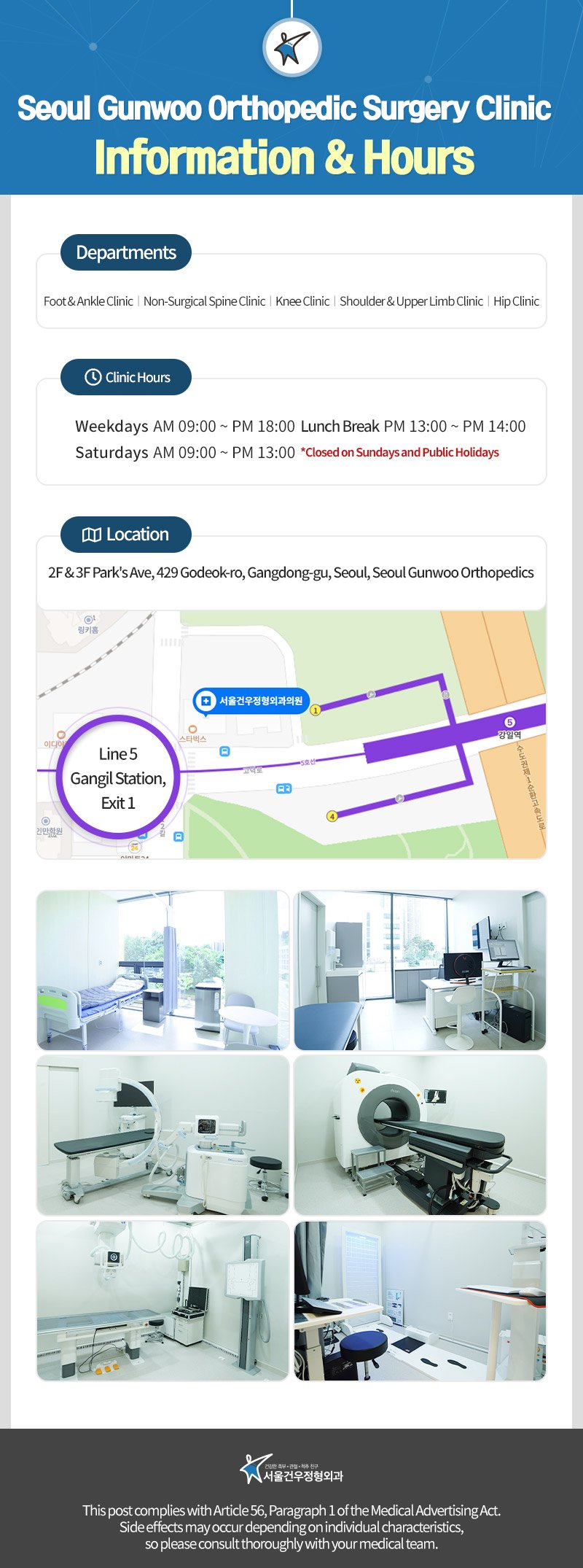
A.Seoul Gunwoo Orthopedic Surgery Clinic is at 2F–3F, 429 Godeok-ro, Gangdong-gu, Seoul, Republic of Korea, in front of Gangil Station Exit 1. Call 02-426-9876 to ask about a consultation.
Clinic Information
| Clinic | Seoul Gunwoo Orthopedic Surgery Clinic |
|---|---|
| Specialty | Orthopedics |
| Address | 2F-3F, 429, Godeok-ro, Gangdong-gu, Seoul, Republic of Korea |
| Phone | 02-426-9876 |
| Website | https://seoulfoot.sillajewelry.com |
| Specialist | Specialist care |
 Seoul Gunwoo Orthopedic Surgery Clinic