
When to See an Ankle Surgery Specialist in Seoul
Ankle pain can arise from an injury or develop gradually as a joint or surrounding tissue becomes irritated. The location of the pain, how it started, and whether the ankle feels unstable are useful details to discuss during an orthopedic assessment. At Seoul Gunwoo Orthopedic Surgery Clinic, our care focuses on the foot and ankle, including ligaments, tendons, cartilage, fractures, and arthritis. An assessment is the starting point for deciding whether treatment should be nonsurgical or whether an operation needs to be discussed.
Symptoms Worth Discussing
Pain after a sprain, recurring ankle instability, or difficulty returning to ordinary activities can be reasons to seek an assessment. Symptoms around the Achilles tendon or heel also deserve attention when they interfere with walking or exercise. The attending doctor can consider how the symptoms began and whether they are improving. Persistent discomfort does not automatically mean surgery is needed. It does, however, give the medical staff a reason to examine the affected area and discuss appropriate next steps.
Before an appointment, consider the circumstances surrounding the problem. For example, note whether discomfort followed a specific injury, appeared during activity, or developed without an obvious event. It can also help to describe whether the ankle feels weak or unstable, and whether symptoms occur during walking, exercise, or rest. If the problem has happened before, explain what treatment you have already tried and how your symptoms responded. These details give the attending doctor context for the examination and help keep the discussion focused on your concerns. If you have relevant medical records or previous imaging, bringing them can support the conversation. The assessment and any further investigation are tailored to the individual; a diagnosis or treatment plan should not be assumed from symptoms alone.
An ankle assessment starts with the history of the problem as well as the symptoms present today. Surgery is one possible part of care, not a conclusion to reach before the examination.
Foot and Ankle Conditions Covered
Our clinic provides care for ankle ligament and Achilles tendon conditions, bunions, heel pain, and plantar fasciitis. Our published surgical work also covers ankle cartilage, ankle arthritis, and fractures. These conditions affect different structures, so an accurate discussion of the affected area matters. For example, discomfort beneath the heel calls for a different assessment from an ankle that repeatedly gives way. The treatment conversation begins with the individual condition rather than a standard operation for every patient.
For heel pain and plantar fasciitis, our clinic discusses assessment, stretching, shockwave therapy, and persistent symptoms. These approaches belong to a broader orthopedic consultation and should not be assumed to suit every cause of heel pain. Ankle ligament care, by contrast, may involve a discussion of stability and, when appropriate, repair or reconstruction. Achilles tendon care concerns the tendon at the back of the ankle, while cartilage and arthritis discussions focus on the joint. Bunion care addresses a different part of the foot and can include surgical correction when indicated. If you are unsure which structure is involved, describe the location and pattern of your symptoms rather than trying to identify the condition yourself. The attending doctor can explain the findings and the options relevant to your circumstances.
Preparing for an Orthopedic Assessment
A consultation is an opportunity to explain both your symptoms and what you need to do in daily life. Be ready to discuss activities that provoke discomfort, any previous injuries, and treatments you have already received. If you take medication or have medical conditions that could be relevant to treatment, share that information with the medical staff. You can also bring a written list of questions so that important concerns are not overlooked during the appointment.
Questions can be practical: What is causing the symptoms? What are the treatment options? What would recovery involve if an operation is recommended? Ask the attending doctor to explain any unfamiliar terms and to distinguish between a diagnosis, a proposed procedure, and expected recovery steps. Understanding the reason for a recommendation is as important as knowing its name. If more information is needed before a decision can be made, ask what the next step would be.
Our medical staff includes Dr. Choi Hong Joon, whose background includes foot and ankle medicine, clinical practice, and research. Dr. Min Kyong Dae is an orthopedic specialist whose listed training includes arthroscopy and sports medicine. A consultation gives you an opportunity to discuss your own condition with the attending doctor and understand the recommended approach. The relevant expertise and treatment plan depend on the problem being assessed, not simply on the name of a procedure.
Procedures an Ankle Surgery Specialist in Seoul May Discuss
Surgical treatment depends on the diagnosis, the structures involved, and the individual’s symptoms and goals. Our clinic’s published techniques include Modified Broström ligament repair, ligament reconstruction, and ultrasound-guided Achilles repair. Published surgical work also covers ankle cartilage, ankle arthritis, fractures, and bunions. A named technique is not a recommendation by itself: the attending doctor must first determine whether surgery is appropriate and which approach fits the condition. Ask how a proposed procedure addresses the problem identified during your assessment.
Ankle Ligament Repair and Reconstruction
Ankle ligaments help support the joint, and an injury can sometimes leave a person concerned about recurring instability. Our clinic’s published work includes ankle ligament repair and reconstruction. The Modified Broström technique is one named repair method; ligament reconstruction is another approach discussed in our published information. The choice between treatments depends on the assessment. During a consultation, ask what the examination suggests about your ankle and why a particular treatment is being considered.
If surgery is proposed, a useful discussion goes beyond the procedure name. Ask the attending doctor which ligament structures are involved, what the operation is intended to address, and what alternatives are appropriate in your case. It is also reasonable to ask how the planned approach relates to your injury history and activity needs. Repair and reconstruction are distinct terms, so request an explanation in plain English if the difference is unclear. Before making a decision, discuss the anticipated recovery plan, any restrictions, and the potential risks relevant to the proposed procedure. Recovery and changes in symptoms may take time depending on the individual condition. The purpose of the consultation is to make an informed choice with the medical staff, rather than to assume that one technique is suitable for every ankle injury.
Ligament repair and reconstruction address ankle stability in different ways. The attending doctor should explain why a particular approach is relevant to the findings and what recovery may involve.
Achilles Tendon and Other Surgical Care
Our clinic’s published surgical work includes Achilles tendon repair, including an ultrasound-guided technique. The Achilles tendon is located at the back of the ankle, and symptoms in that area should be assessed in the context of how they began and how they affect movement. If repair is discussed, ask what the examination shows and how the proposed technique would be used. The attending doctor can also explain the expected care plan after treatment.
Our published surgical focus extends beyond ligaments and tendons to ankle cartilage, ankle arthritis, and fractures. Techniques named in our clinic’s published information include OATS and SMO, and absorbable screws are listed for bunion and fracture fixation. These names do not indicate that a particular patient needs any of these procedures. Their relevance depends on the diagnosis and the attending doctor’s assessment. When reviewing a proposed operation, ask which structure is being treated, whether an implant or fixation device is planned, and what follow-up is expected. You can also ask how the procedure relates to any previous treatment you have received. A clear explanation should connect the technique to your specific condition and help you understand the decision without relying on technical terminology alone.
Bunion and Heel Pain Care
Bunions and heel pain are foot conditions that can affect walking, but they require different assessments. Our clinic provides bunion care and lists minimally invasive bunion surgery using the MICA technique among its published procedures. For heel pain and plantar fasciitis, our care includes assessment and discussion of stretching and shockwave therapy. The attending doctor can explain which options are relevant after considering the location of symptoms and the findings of the assessment.
If a bunion operation is considered, ask what correction is planned and what recovery would involve. If heel discomfort is the primary concern, describe when it occurs and how it affects your activities. A treatment used for one foot condition should not be assumed to apply to another. A consultation can help clarify the diagnosis and whether the next step is a treatment discussion, further assessment, or a review of care already tried.
| Area of care | Published treatment or technique |
|---|---|
| Ankle ligaments | Modified Broström repair and ligament reconstruction |
| Achilles tendon | Ultrasound-guided repair |
| Bunions | MICA minimally invasive bunion surgery |
| Heel pain and plantar fasciitis | Assessment, stretching, and shockwave therapy |
| Bunion and fracture fixation | Absorbable screws |
The table summarizes published areas of care and techniques; it is not a list of treatments that every patient will need. Some conditions can be discussed without proceeding to surgery, while others may require a more detailed evaluation before options can be explained. If a procedure is recommended, ask the attending doctor to describe the intended purpose, alternatives, and recovery considerations. The most useful treatment plan is one that is explained in relation to your diagnosis and circumstances.
Planning a Visit With an Ankle Surgery Specialist in Seoul
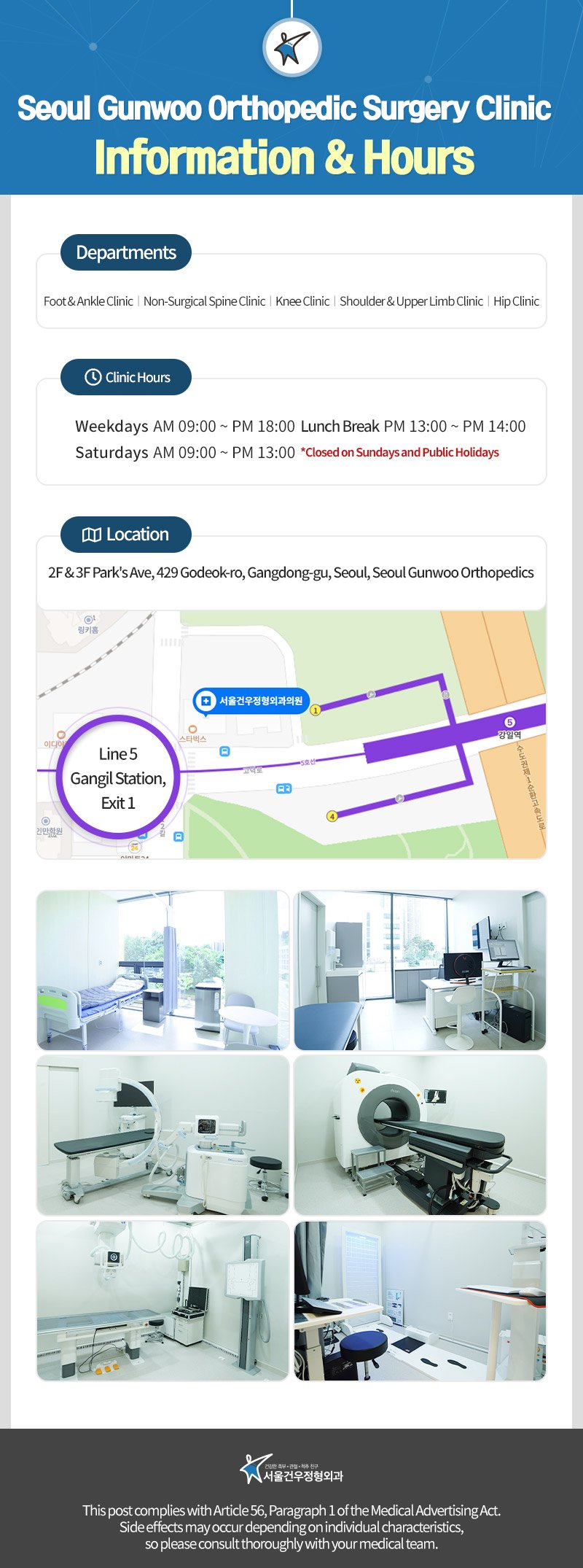
Planning ahead can make an orthopedic consultation more productive. Bring relevant information about your symptoms and previous care, and think about the activities you would like to return to or maintain. If surgery is part of the discussion, ask about preparation, recovery, and follow-up before deciding how to proceed. Seoul Gunwoo Orthopedic Surgery Clinic offers consultations on weekdays and Saturdays, with a weekday lunch break. The practical details below can help you arrange a visit and prepare for the conversation.
Questions to Ask About Treatment
Start by asking the attending doctor to explain the diagnosis and which findings support it. Then ask what treatment choices are appropriate, including whether nonsurgical care is an option for your condition. If an operation is proposed, request a plain-language explanation of its purpose and the structures involved. You can also ask about potential risks, the expected recovery process, and whether you will need help with ordinary activities after treatment.
It is useful to distinguish between the aim of treatment and a promised outcome. An operation may be intended to address a particular injury or joint problem, but individual recovery and symptom changes depend on the condition and other clinical factors. Ask what progress the medical staff will look for and when follow-up will be arranged. If you have questions about work, exercise, or travel, describe the demands involved rather than asking only for a general recovery estimate. The attending doctor can discuss restrictions in the context of your proposed treatment. You should also mention concerns about medication, prior procedures, or support at home. Make sure you understand the plan before agreeing to treatment. If an explanation is unclear, ask for it to be repeated in simpler terms.
A useful consultation connects the diagnosis, treatment options, and recovery plan. Ask questions until you understand the purpose of the proposed care and the decisions still to be made.
Points to Consider Before Treatment
Any surgical decision involves weighing the proposed benefits against potential risks and the demands of recovery. The details depend on the procedure and your health, so discuss them directly with the attending doctor. Ask what preparation is needed, how the treated area will be protected, and what symptoms should prompt you to contact the medical staff. If nonsurgical care is recommended, ask how to use it and when your progress should be reviewed.
Recovery instructions are individual. The plan may address activity, care of the treated area, follow-up appointments, and rehabilitation where appropriate. Before leaving the consultation, make sure you know whom to contact if you have questions and what to do if your condition changes. Changes in symptoms may take time depending on the individual condition, and the attending doctor can explain what to expect for the treatment being considered. If you experience a significant change before an appointment, seek timely medical advice rather than waiting for a routine visit. For a severe injury or an urgent concern, seek urgent medical care. Keeping a record of questions and following the instructions given by your medical staff can help you take part in your care without relying on a general recovery timetable.
Consultation Hours and Access
Our clinic is in Gangdong-gu, Seoul, near Gangil Station, Exit 1. Consultation hours are shown below in Korea Standard Time. When planning a visit, allow for the weekday lunch break and consider bringing any records relevant to your foot or ankle concern. If you want to discuss a particular procedure, note your questions in advance so the attending doctor can address them alongside the assessment.
A first discussion can cover the history of your symptoms, their effect on daily activities, and any care you have already received. You do not need to know the name of a procedure before seeking an assessment. The medical staff can explain the findings and discuss the next steps appropriate to your condition. If you have practical questions about arranging a visit, contact our clinic using the number in the frequently asked questions below.
| Day | Consultation hours |
|---|---|
| Monday to Friday | 9:00 a.m. to 6:00 p.m.; lunch break from 1:00 p.m. to 2:00 p.m. |
| Saturday | 9:00 a.m. to 1:00 p.m. |
| Sunday and public holidays | Closed |
Before your visit, consider which concerns matter most to you: a new injury, recurring instability, persistent heel pain, or questions about an existing diagnosis. A focused description helps the attending doctor understand what you want from the appointment. You can then discuss whether the next step is assessment, a review of treatment options, or planning for a proposed procedure. Bring your questions and make sure the explanation addresses your individual circumstances.

Frequently Asked Questions
Q.What kind of care does Seoul Gunwoo Orthopedic Surgery Clinic provide?
A.Our clinic provides foot and ankle-focused orthopedic care, including care for ankle ligament conditions, Achilles tendon problems, bunions, heel pain, and plantar fasciitis. Our published surgical work also covers ankle cartilage, ankle arthritis, and fractures.
Q.Who might consider an appointment at our clinic?
A.An appointment can be useful for someone with ankle instability, Achilles tendon symptoms, a bunion, or persistent heel pain. The attending doctor can assess the concern and discuss appropriate care.
Q.What ankle treatments can be discussed?
A.Our clinic’s published techniques include Modified Broström ligament repair, ligament reconstruction, and ultrasound-guided Achilles repair. The attending doctor can explain whether a treatment is relevant after assessing the condition.
Q.What should I prepare before my appointment?
A.Be ready to describe when your symptoms began, how they affect your activities, and what treatment you have already tried. Bring relevant medical records or previous imaging if you have them.
Q.Where is Seoul Gunwoo Orthopedic Surgery Clinic, and how can I contact our clinic?
A.Our clinic is at 2F–3F, 429 Godeok-ro, Gangdong-gu, Seoul, Republic of Korea, near Gangil Station, Exit 1. For consultation or booking questions, call 02-426-9876.
Clinic Information
| Clinic | Seoul Gunwoo Orthopedic Surgery Clinic |
|---|---|
| Specialty | Orthopedics |
| Address | 2F-3F, 429, Godeok-ro, Gangdong-gu, Seoul, Republic of Korea |
| Phone | 02-426-9876 |
| Website | https://seoulfoot.sillajewelry.com |
| Specialist | Specialist care |
 Seoul Gunwoo Orthopedic Surgery Clinic